
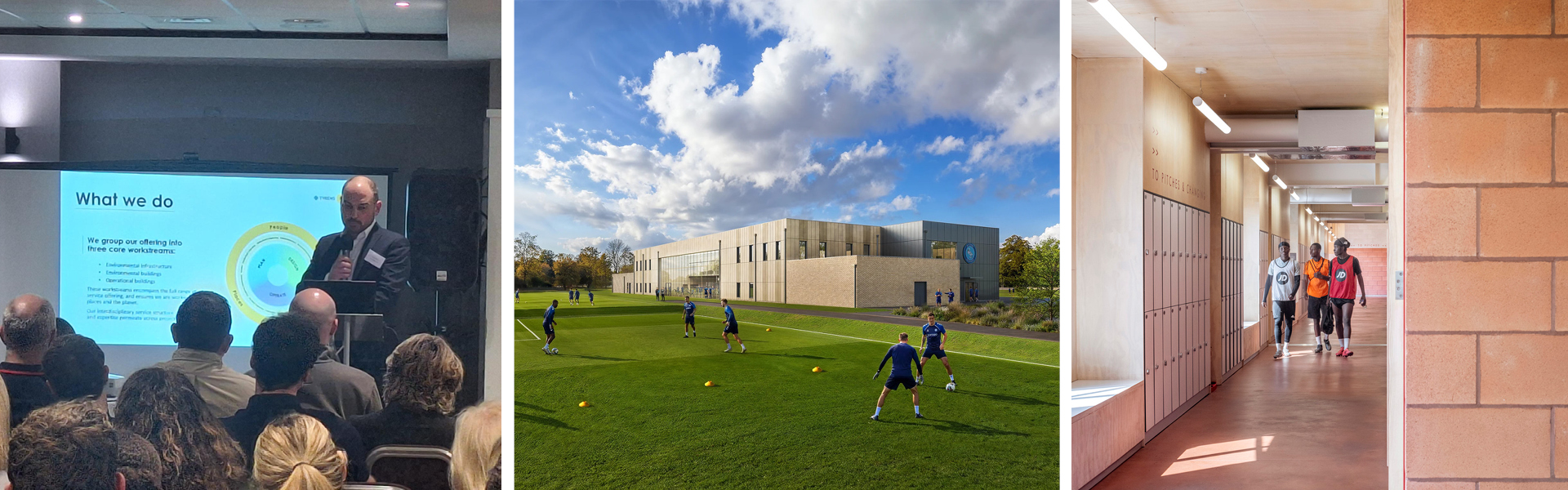
United by Sport brings together sporting bodies, local authorities an industry around a shared ambition: to unlock more of the social and economic potential of investment in sport. After its latest North East event, Andy Hart explores what that could mean for the region, from grassroots participation to elite performance.
It was a privilege to attend and present at the latest ‘United by Sport’ event, at Durham Cricket’s Riverside Ground.
United by Sport creates a forum for organisations across sport, government and industry to look at how sporting infrastructure can support wider economic and community regeneration. Led by Turner & Townsend, this edition was focused on capital investment in sport, particularly around the North East.
Alongside discussions about investment and facilities, we heard powerful stories from local sporting talent, including professional golfer Jess Baker and Olympic BMX Freestyle silver medallist Kieran Reilly.
Those individual journeys all helped bring the bigger question into focus: how can we ensure that there is a sporting structure in place, across the North East, that allows more people to participate, develop and ultimately succeed here?
The region already has passionate communities, great sporting assets and exceptional talent. Devolution gives us an opportunity to connect them.
Thinking from street to elite
At Tyréns Hilson Moran, we see sport as a connected pathway: from community participation and grassroots provision, through clubs, schools and academies, to performance environments, elite venues and major events.
It is a “street to elite” approach based on a straightforward idea: every facility should strengthen the pathway before it and unlock the opportunity after it.
Clubs and schools can build belonging and make pathways visible. Academies develop talent, while performance centres connect athletes with coaching, sports science, medicine and recovery. Elite venues and major events can generate profile and inspiration that feeds back into grassroots participation.
When these elements are planned independently, we build facilities. When they are planned together, we create a sporting ecosystem.
Devolution makes that particularly relevant. As more decisions about infrastructure, economic growth, health and place are made closer to the communities they affect, regions have an opportunity to connect investment in sport with those wider priorities.
Designing places where people can perform
For athletes, thermal comfort, indoor air quality, lighting, acoustics, digital connectivity and inclusive design can all influence how they train, recover and perform. In elite sport, where increasingly small margins separate success from failure, those details matter.
That suggests a more human-centred starting point for design. How does an athlete move between training, coaching, nutrition, treatment, analysis and recovery? Where does the environment create unnecessary friction? How can engineering, sports science and technology create better conditions for performance?
And it goes beyond athletes. Can coaches develop their careers here? Can specialists access the facilities they need? Can young people see a future here?
Making investment work harder
We should also think beyond opening day when judging whether investment in sporting infrastructure has succeeded.
A better model considers the whole life of an asset: plan, design, deliver, operate and optimise.
That means planning around outcomes, designing using evidence and then measuring how a facility actually performs. Data and experience can then be used to improve, adapt and decarbonise it throughout its life.
When funding is constrained, making every pound work harder cannot simply mean making buildings cheaper. It means creating assets that are efficient to operate, adaptable, well used and capable of delivering value for decades.
Connecting the North East’s sporting potential
That, for me, is the key opportunity created by events like United by Sport.
Devolution will not automatically create better sporting outcomes. But it gives regions an opportunity to connect decisions that have historically been made separately.
Grassroots participation can connect to talent pathways. Elite sport can connect with universities, research and skills. Sporting infrastructure can support regeneration and economic development. Major events can inspire participation. And capital investment can be linked to long-term human and operational performance.
But making those connections requires the right people to be part of the same conversation. That is why initiatives like United by Sport matter: they create a forum to bring together sporting bodies, local and regional decision-makers, investors and industry around a shared ambition, rather than approaching each opportunity in isolation.
For the North East, the ambition can be captured simply: Build the place. Grow the talent. Keep the talent.
Our work at Tyréns Hilson Moran spans sporting environments at very different scales, from training and performance facilities to major international stadiums. That experience reinforces an important point: successful sporting infrastructure depends on much more than the building itself. Engineering, environmental performance, acoustics, sustainability and the experience of athletes, staff and spectators all have a part to play.
The opportunity is to apply that thinking at a regional scale. The North East already has the passion, heritage and talent. By connecting investment with a clearer pathway from grassroots participation to elite performance, there is an opportunity to create sporting infrastructure that delivers value far beyond opening day.


